Many years ago, when I was still a fairly new academic advisor, I met with a student for a graduation checkout appointment.
The student had done everything right.
They were graduating with a 4.0 GPA. They were a Presidential Scholar. They had completed every requirement of their degree program and had been successful throughout their college career.
As I reviewed their record, I remember being impressed.
Eager to hear about their plans, I asked, “So, what’s next?”
“I don’t know. I guess I’ll just go home.”
I’ve thought about that conversation many times over the years.
How does a student do everything perfectly and still not know where they want to go next?
The more I’ve reflected on that moment, the more I’ve come to understand that preparing for a career requires more than simply completing the requirements of a degree.
Students build careers not only through coursework, but also through experiences that help them understand themselves, explore industries, develop relationships, and connect their education to future opportunities.
Now imagine that same student.
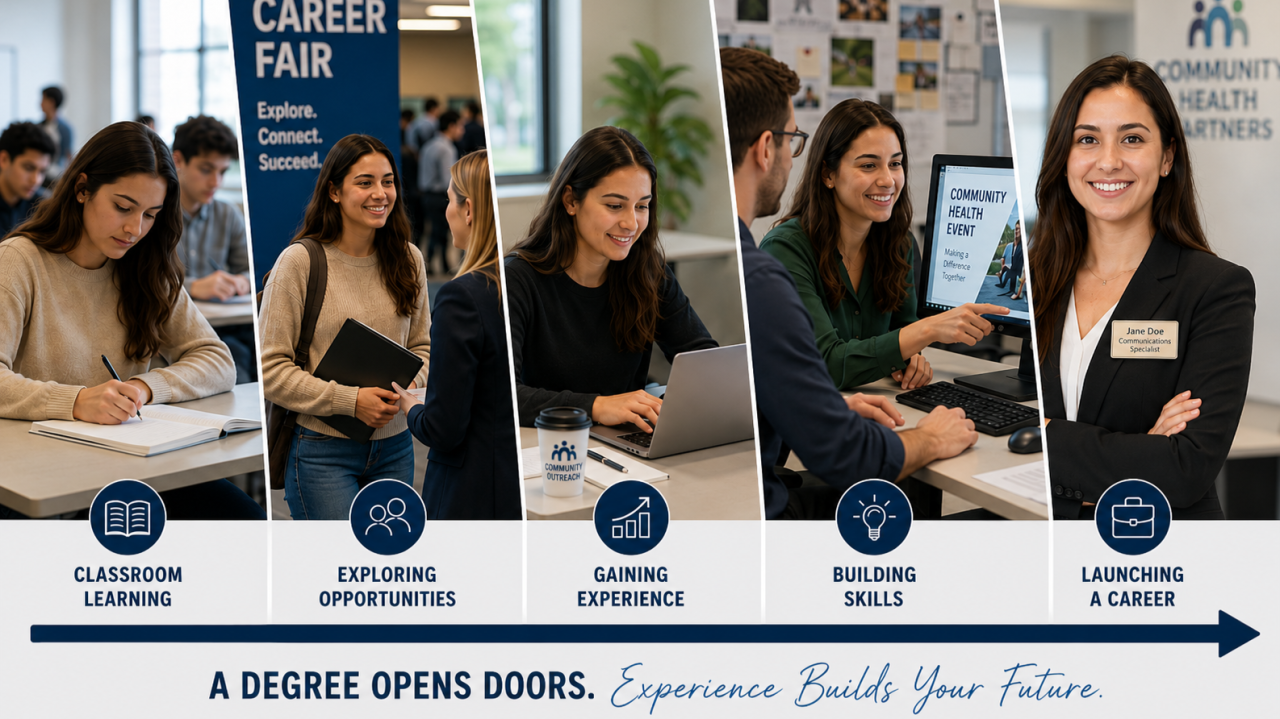
During her freshman year, she meets with an advisor and completes a career assessment. Through conversations and reflection, she begins learning more about her strengths, values, interests, and possible career directions.
She discovers that she enjoys communication, creativity, relationship-building, and helping others. Marketing and public relations begin to catch her attention.
During her first semester, she attends a career fair.
To be honest, she’s nervous.
She doesn’t have much experience. She isn’t looking for an internship. She isn’t even completely sure what she wants to do.
Still, she walks around, talks with employers, and asks questions.
One organization catches her attention. It is a regional healthcare organization with a strong focus on community outreach and education. She speaks briefly with a communications manager, picks up a business card, and moves on.
Nothing remarkable happens.
At least not yet.
After her freshman year, she begins looking for opportunities to gain experience. Through family connections and conversations with people she knows, she finds an opportunity to help a local nonprofit organization with social media, event promotion, and community outreach.
It isn’t a fancy internship.
It isn’t a position hundreds of students are competing for.
It’s simply an opportunity to learn.
She helps promote events, attends planning meetings, creates content, and watches how people work together to support a mission they care deeply about.
For the first time, she begins to see how communication skills create real impact.
The classroom feels different.
When she returns to campus for her sophomore year, something changes.
In one of her communication courses, students are discussing audience engagement and message effectiveness. Instead of relying only on textbook examples, she finds herself thinking about events she helped promote during the summer and the challenges of reaching different audiences.
The concepts have context now.
The classroom feels different because she has experienced some of what she is learning.
During her sophomore year, she attends another career fair.
This time she notices the same healthcare organization she met during her freshman year.
The conversation is different.
She talks about the nonprofit experience she gained over the summer. She asks better questions. She learns more about the organization’s communication team and community outreach efforts.
After sophomore year, she seeks another opportunity.
This time she works for a larger organization.
The experience is valuable, but it teaches her something unexpected.
While she enjoys the work, she realizes she misses the mission-driven culture of the nonprofit organization she worked with the previous summer.
For the first time, she begins recognizing how important organizational values are to her.
She isn’t just learning about careers.
She’s learning about herself.
Each experience builds on the one before it.
By junior year, she attends another career fair.
She sees the same healthcare organization again.
Only now she has experiences to discuss.
Instead of introducing herself as a student interested in communications, she talks about projects she has worked on, events she has helped coordinate, and lessons she has learned from two summers of professional experience.
The communications manager remembers her.
A few weeks later, she interviews for an internship.
This time, she gets the position.
What began as a nervous conversation during her freshman year has turned into a meaningful professional opportunity.
That same year, she attends a communications conference with faculty and fellow students. She listens to professionals discuss public relations, digital storytelling, community engagement, and emerging trends in the field.
She leaves energized.
Each experience builds on the one before it.
Each experience teaches her something.
Each experience helps her connect her education to a future she can begin to see.
She has spent four years building a career.
By senior year, she still has the strong GPA.
She still has the quality education.
But she has something else as well.
She has spent four years building a career.
When someone asks what comes next, the answer is no longer, “I guess I’ll just go home.”
Instead, she talks excitedly about the healthcare organization where she interned. She explains how the organization’s mission aligns with her values and how the position would allow her to combine communication, community engagement, and relationship-building.
She talks about pursuing a master’s degree while working because the organization offers tuition assistance.
She talks about future goals, professional growth, and the impact she hopes to make.
The difference wasn’t intelligence.
The difference wasn’t grades.
The difference was that one student focused primarily on earning a degree, while the other spent four years intentionally building a career alongside that degree.
A quality education remains one of the most important investments a student can make.
But education becomes even more powerful when students actively seek opportunities to connect what they are learning to the world beyond the classroom.
- Attend the career fair.
- Talk with professionals.
- Seek work experiences.
- Volunteer.
- Explore industries.
- Ask questions.
- Build relationships.
Not because they are required.
Because careers are built one experience at a time.
A degree provides knowledge and skills that prepare students for opportunities.
What students do beyond the classroom often helps them recognize, pursue, and create those opportunities for themselves.
Looking back, I still think about that student who graduated with a 4.0 GPA and no clear sense of what came next.
Over the years, I’ve come to understand that knowledge alone is rarely enough to prepare students for success after graduation. Students also need opportunities to develop the experiences, relationships, self-awareness, and professional connections that help them identify and pursue meaningful opportunities.
The students who begin building those experiences early in their college journey often graduate with more than a degree. They graduate with a clearer sense of direction and a stronger foundation for building a meaningful career.